chris@alfredturbo.com
+86-18112348562
Language
Please Choose Your Language

Views: 38 Author: Site Editor Publish Time: 2026-03-04 Origin: Site


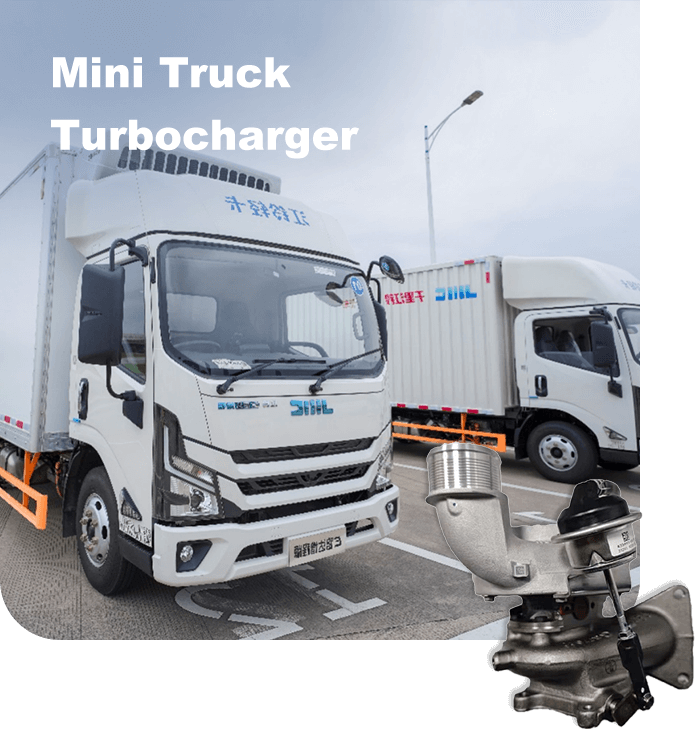
For long-distance truck drivers, the engine is the "heart" of the truck, and the turbocharger is like a "cardiotonic" injected into this heart. Without consuming extra fuel, it can make the truck burst out stronger power with the same displacement — carry more goods, climb steeper slopes, and run faster. This is why we cannot do without it for long-distance transportation and heavy loading. Simply put, without a turbocharger, a truck with heavy load climbing a slope is like "a clever housewife can't cook a meal without rice" — the power is simply insufficient.
Many truck drivers think that a turbocharger is an "extra power pump" installed on the engine, but this is not the case. It has no independent power source and works entirely driven by the waste gas discharged from the engine. It is equivalent to reusing the originally wasted waste gas energy to improve the working efficiency of the engine. Simply put, without a turbocharger, the engine can only suck air by "itself", resulting in less air intake and weak power; with it, there is something "helping the engine suck air", resulting in more air intake, sufficient power, and no waste of energy.
You don’t need to remember complicated professional terms; just remember: the core of a turbocharger is "1 rotating shaft", which connects 4 core components in series, plus 1 intermediate body for connection, to work normally. The 4 core components are: the "air transporter" (compressor wheel), the "safety valve" for pressure (actuator), the "coolant" for air (intercooler), and the "guardian" for high speed (floating bearing and seal); the intermediate body is the "connecting hub" in the middle, responsible for fixing, lubricating and sealing.
In the most popular terms, its working process has 5 steps, which are completed in one go:
① The engine discharges waste gas
② The waste gas impacts the turbine wheel to rotate
③ The turbine wheel drives the compressor wheel to rotate at high speed through the rotating shaft
④ The compressor wheel sucks in air and compresses it, and the hot air is cooled by the intercooler
⑤ The cooled high-pressure air is sent into the engine, which injects more fuel and does more work, resulting in sufficient power. The pressure is controlled by the actuator throughout the process, the floating bearing ensures the stability of the rotating shaft, and the intermediate body is responsible for lubrication and sealing. As long as the engine is exhausting, it will work, and the maximum rotating speed of the rotating shaft can reach more than 100,000 revolutions per minute.
The compressor wheel is installed at the front of the turbocharger, close to the air filter. From the outside, it looks a bit like the blades of an electric fan, but it is completely different from the fan at home. Its core is a disc covered with curved blades, which are shaped like "small spoons". There is a round hole in the middle for installing the rotating shaft. The surface is smooth without extra protrusions, so it can be distinguished from other components at a glance.
Its material is not ordinary. Because it has to withstand high-speed rotation of more than 100,000 revolutions per minute, as well as huge centrifugal force and air pressure, it is usually made of aluminum alloy or titanium alloy. This kind of material is characterized by being "light and hard". It will not increase the burden on the rotating shaft because it is too heavy, nor will it deform or break when rotating due to insufficient strength, so it can work stably for a long time.
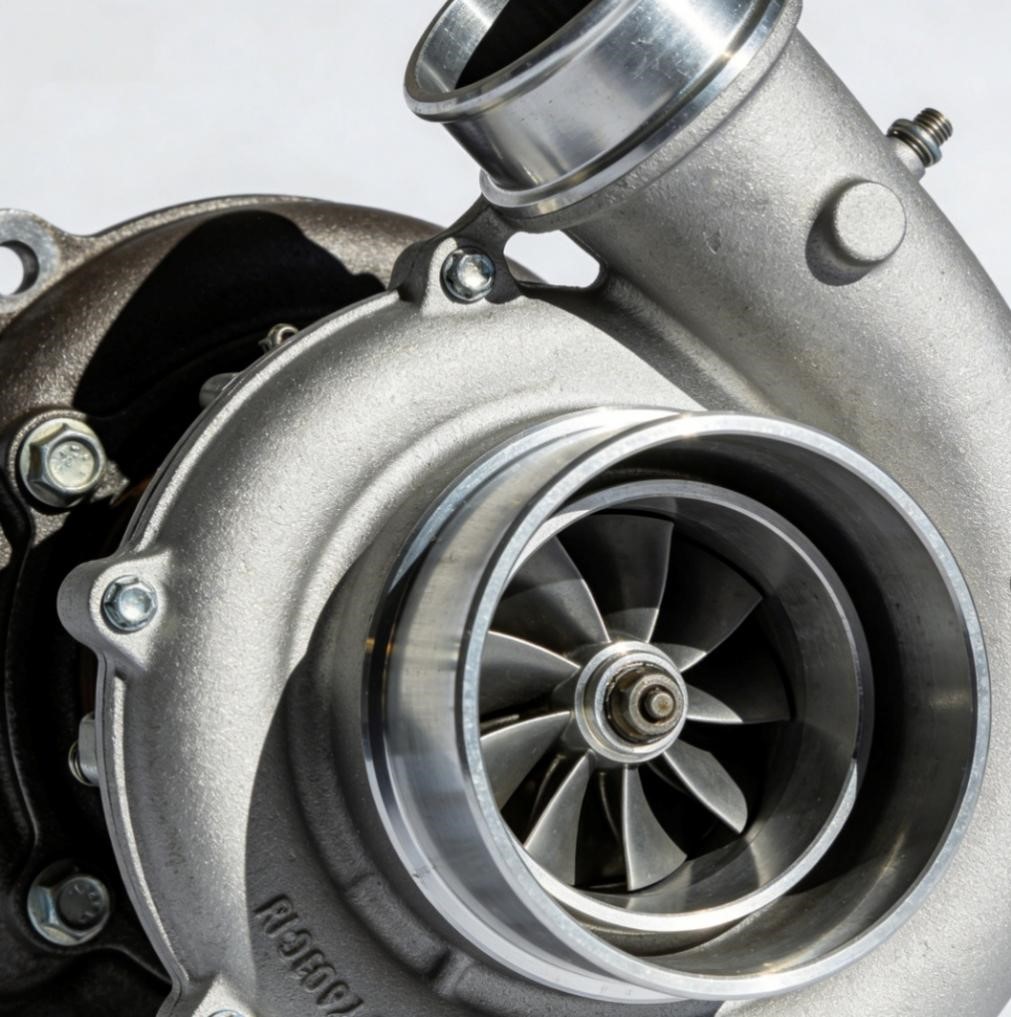
If the turbocharger is compared to a factory, the compressor wheel is the core production line. Its task is very simple: "suck in" fresh air from the outside and "squeeze it out" forcefully to make the air dense and compact, so that diesel can burn more vigorously in the engine and the power can be stronger. Simply put, it is responsible for "feeding air" to the engine — the more it feeds, the more powerful the engine is.
When the waste gas discharged from the engine pushes the turbine wheel at the rear to rotate, the turbine wheel will drive the compressor wheel at the front to rotate together through a rotating shaft, with a rotating speed of up to more than 100,000 revolutions per minute, thousands of times faster than the electric fan at home. The high-speed rotating impeller generates strong suction at the center to suck fresh air from the center; the air runs out along the "small spoon"-shaped blades. In this process, the blades continuously do work on the air, compressing it more tightly — the pressure increases and the temperature also rises. Finally, these compressed high-pressure hot air will be sent to the intercooler for cooling, and then into the engine cylinder.
The working environment of trucks is very harsh. The compressor wheel not only has to withstand the centrifugal force of high-speed rotation, but also the friction and high temperature of air. Therefore, the current impeller technology is more and more advanced. Some adopt precision casting, and some adopt forging. The purpose is to ensure that the blades do not deform or break under high-speed rotation and can adapt to the harsh working environment of trucks for a long time.
The compressor wheel is prone to two problems: one is carbon deposition and deformation of the blades, and the other is blade breakage. If there is too much carbon deposition or deformation on the blades, they cannot suck in and compress air normally, resulting in insufficient engine air intake. The most obvious performance is power reduction — it is difficult to start with full load, there is no strength when climbing slopes, and the truck cannot run fast even when the accelerator is stepped on to the bottom; at the same time, insufficient air intake will lead to insufficient fuel combustion and obvious increase in fuel consumption. If the blades break, they will make a "buzzing" abnormal noise when rotating at high speed, and in severe cases, it will directly lead to the failure of the turbocharger, so it must be inspected and maintained in time.
If the compressor wheel is the "one who does the work", the actuator is the "one who manages the work". Its core function is to monitor the boost pressure and prevent the engine from being "damaged" by excessive pressure. It is equivalent to the "safety valve" of the turbocharger, and also like the "brain", which controls the pressure throughout the process to ensure the safe work of both the turbocharger and the engine.
Its working logic is very simple and fully automatic, without manual operation by us truck drivers: when the engine speed is low, there is little waste gas, the turbine rotates slowly, and the boost pressure is low. At this time, the actuator is in the "closed" state, allowing all waste gas to push the turbine to quickly establish sufficient boost pressure to ensure the truck has power; when the engine speed increases, there is more waste gas, and the boost pressure is about to exceed the standard, the actuator will "open", directly releasing part of the waste gas without passing through the turbine wheel, slowing down the turbine speed, reducing the boost pressure, and stabilizing it within a safe range.
The actuator is installed on the side of the turbocharger, small and exquisite, mostly cylindrical or square, like a "small can". Its internal core has three components: diaphragm, spring and push rod. There is also a wire (or vacuum tube) outside, connected to the engine control unit (equivalent to the "brain" of the engine), and a connecting rod connected to the wastegate valve on the turbine side.
The functions of these three core components are clear: one side of the diaphragm is connected to the control signal (vacuum tube or electric signal), and the other side is pressed against the spring, which is equivalent to a "sensor" that can sense changes in boost pressure; the spring is responsible for providing elastic force, and the magnitude of the elastic force directly determines the standard value of the boost pressure, which is equivalent to a "setter"; the push rod is responsible for transmitting power. When the diaphragm moves, it drives the push rod, and the push rod then pulls the valve of the wastegate valve to open and close, which is equivalent to an "executing hand".
[Image: Detailed view of the actuator, showing the overall appearance, connecting rod and wire interface, clearly presenting its small and precise characteristics, marking the connecting rod, control interface and shell to reflect its connection and control structure]
There are mainly two types of actuators for truck turbochargers, both of which are automatically controlled. We don’t need to manage them, just know the difference between them: one is a vacuum actuator, which works by the vacuum degree of the engine intake manifold, with simple structure and low cost, and is mostly used in old trucks; the other is an electronic actuator, which works by electric signals, precisely controlled by the engine "brain", with faster response and more accurate pressure control, and is used in many new trucks now.
The most common problems of the actuator are jamming, diaphragm damage or spring failure. If the actuator is jammed and the push rod cannot open or close the wastegate valve, either the pressure is too low (wastegate valve is always open) and the truck has no power; or the pressure is too high (wastegate valve is always closed), resulting in engine detonation and increased fuel consumption. The most intuitive performance is fluctuating power — sometimes there is power when accelerating, sometimes there is no power. The fault light may also light up on the instrument panel. In addition, severe jolting of the truck may also cause the push rod connection to loosen and produce abnormal noise, which should be inspected in time.
As we mentioned earlier, after the compressor wheel compresses the air, the air temperature will become very high, like a just-cooked steamed bun, hot. This kind of hot air has low density and low oxygen content, so it burns weakly and is prone to cause engine detonation. The function of the intercooler is to "cool down" this hot air, make it calm down, and turn it into cold air with higher density and higher oxygen content. In this way, the engine burns more vigorously, and the engine is also protected, reducing faults.
The intercooler is usually installed at the front of the truck head, looking like the cooling fins of a radiator. Its principle is similar to that of radiator cooling, which is "wind impact cooling". When the truck is running, the outside cold wind will blow directly on the cooling fins of the intercooler; while the hot air sent by the compressor will flow in the internal pipes of the intercooler. The heat is transferred to the cooling fins through the metal wall and then taken away by the cold wind. In this way, the hot air becomes cold air, and the temperature can drop by dozens of degrees Celsius.
The interior of the intercooler is full of dense pipes and fins, which is its core structure: the pipes are channels for hot air to pass through, which must be well sealed and not leak air. Once air leaks, the boost pressure will drop and the power will be affected; the fins are used for heat dissipation. The larger the area of the fins, the better the heat dissipation effect, but the design must also be balanced — too dense fins will block the wind, which will affect heat dissipation; too sparse fins will not provide enough heat dissipation. Data show that for every 10℃ decrease in intake air temperature, the engine power can be increased by 3%-5%, which is not a small number for trucks carrying heavy loads.
[Image: Detailed view of the intercooler, showing the external cooling fins and internal pipe structure, marking the pipes, fins, air inlet and air outlet to clearly present its wind impact cooling structural characteristics]
The compressor wheel and the turbine wheel are connected to a rotating shaft, which rotates at more than 100,000 revolutions per minute, faster than the speed of an F1 racing car. Ordinary bearings cannot withstand this speed, so special "floating bearings" must be used. Unlike ordinary bearings, it does not contact directly (hard to hard), but leaves a very small gap between the shaft and the bearing seat, which is filled with engine oil. When rotating at high speed, the engine oil forms an oil film, and the shaft actually rotates "floating" on the oil film. This design has low friction, good heat dissipation, can automatically adjust the center, absorb vibration, and protect the rotating shaft from wear.
At both ends of the rotating shaft, there is high-temperature waste gas on one side and compressed air on the other, with engine oil for lubrication in the middle. Therefore, a precise sealing system must be in place to prevent "odor mixing". The core of the sealing system is the seal ring, which is closely attached to the rotating shaft like a piston ring, strictly separating oil and gas: on the one hand, it prevents engine oil from leaking out, such as leaking to the compressor or turbine side and being burned by waste gas (which will cause blue smoke from the exhaust pipe and increased engine oil consumption); on the other hand, it prevents waste gas from entering, polluting the engine oil, causing engine oil deterioration, and damaging the internal components of the engine and turbocharger.
The most common problems of the intercooler are air leakage and dust accumulation on the cooling fins. If the pipes leak air, the boost pressure will drop and the truck power will be insufficient; if too much dust and catkins accumulate on the cooling fins, it will block the cold wind, reduce the heat dissipation effect, increase the intake air temperature, and lead to power reduction and increased fuel consumption. Therefore, it is necessary to clean the cooling fins regularly at ordinary times. When driving on dusty roads such as construction sites and deserts, the cleaning cycle should be shortened, and air leakage should be repaired in time.
Most faults of floating bearings and seals are related to engine oil: if there is insufficient engine oil, deteriorated engine oil, or inadequate lubrication (such as stepping on the accelerator sharply immediately after a cold start when the engine oil has not yet flowed to the bearings), it will cause bearing wear, oil film rupture, and the rotating shaft will come into direct contact with the bearings, eventually seizing up; after the seal rings are worn, oil leakage and gas leakage will occur, with blue smoke emitting from the exhaust pipe and increased engine oil consumption. Therefore, you must use high-quality engine oil, regularly replace the engine oil, and develop the habit of idling for 1-2 minutes after a cold start and 1-2 minutes before shutting down to protect the floating bearings and seals.
The above is a detailed analysis of the 4 core structures and various components of the turbocharger. From basic understanding to the structure, principle and common problems of each component, it is explained clearly in plain language. In fact, these core components are like a special forces unit, each performing its own duties and cooperating closely: the compressor wheel "transports air", the actuator "controls pressure", the intercooler "cools down and improves efficiency", the floating bearing and seal "provide stable protection", and with the connection and lubrication of the intermediate body, the energy of waste gas can be converted into strong power to make the truck gallop on the highway. Next time when you hear the "hissing" pressure relief sound of the turbocharger or feel the pushing force, don’t forget that these small components are working silently behind the scenes. Do a good job in daily maintenance and pay more attention to abnormal performance, so that the turbocharger can be used longer, have fewer faults, and avoid breaking down on the way affecting the transportation efficiency.