chris@alfredturbo.com
+86-18112348562
Language
Please Choose Your Language

Views: 0 Author: Alfredturbo Publish Time: 2026-08-19 Origin: Site


When it comes to American‑style pickup trucks, most people immediately picture large‑displacement V8 engines with their deep‑throated roars and abundant power reserves. Rugged and hardcore, these are the classic hallmarks of American pickups. In recent years, however, General Motors has completely overturned this long‑held perception. For its core pickup models including the Chevrolet Silverado 1500 and Colorado, GM has widely adopted the 2.7‑liter inline‑four turbocharged engine — the well‑established L3B unit, now officially named TurboMax.
This small‑displacement four‑cylinder engine has taken over the workload formerly handled by V6 and entry‑level V8 powertrains, emerging as the mainstay powerplant for Chevrolet pickups. For overseas pickup owners, off‑road enthusiasts and automotive aftermarket specialists, raw displacement is rarely the primary concern. Instead, they focus heavily on how well its turbocharger performs, its suitability for real‑world operating conditions, long‑term durability, and maintenance‑and‑repair costs over ownership. This article provides a full‑scale breakdown of this pickup‑dedicated 2.7‑liter turbo four‑cylinder engine, with detailed coverage of core turbocharger performance, real‑world driving impressions, long‑term reliability, and practical maintenance guidelines.
Many owners hold the misconception that small‑displacement four‑cylinder engines are merely modified passenger‑car powerplants incapable of withstanding the heavy‑load, towing and off‑road demands of pickup trucks. The L3B / TurboMax engine is fundamentally different. It is an original‑design GM powertrain engineered specifically for pickups. From the earliest design phase, development centered on commercial, off‑road and heavy‑duty pickup use‑cases, resulting in architecture and durability far exceeding conventional four‑cylinder passenger‑car engines.
Moving away from the lightweight design philosophy typical of sedan engines, this powerplant adopts heavy‑duty hardware more akin to industrial diesel engines for enhanced durability. It features an aluminum engine block fitted with ductile iron cylinder liners, delivering exceptional resistance to high temperatures, wear and mechanical distortion. Internally, forged‑steel crankshaft and connecting rods pair with a long‑stroke layout to sustain continuous high‑load, high‑torque output. This setup perfectly accommodates rigorous pickup‑truck scenarios such as towing heavy loads, climbing gradients at full payload, and traversing rough terrain.
First introduced in 2019 for the Silverado and Sierra, this engine replaced the older 4.3‑liter naturally‑aspirated V6 as the primary entry‑level powertrain. Starting in 2023, it became standard equipment across the new Colorado and Canyon model ranges. GM also re‑calibrated this unit for the Cadillac CT4‑V performance sedan, where it produces up to 325 horsepower — solid proof of its substantial hardware ceiling and tuning potential, and its ability to operate across diverse application scenarios.
General Motors offers three different tuning variants for the 2.7‑liter turbocharged four‑cylinder engine, covering daily commuting, light commercial duties and heavy‑duty towing. Strong low‑rpm torque is the defining highlight across all versions and represents the biggest advantage of its turbocharger system.
- Base Colorado variant: Optimized for fuel‑efficient daily driving, delivering 237 horsepower and 259 lb‑ft of peak torque. It excels in city commuting and short‑haul cargo carrying with strong cost‑effectiveness.
- Colorado Turbo Plus mid‑output variant: Output rises to 258 horsepower and 295 lb‑ft of torque, balancing performance and fuel economy for most off‑road and light‑payload applications.
- High‑output Silverado TurboMax variant: The most powerful configuration, rated at 310 horsepower and 430 lb‑ft (approximately 583 N·m) of peak torque, with an exceptionally broad torque plateau spanning 1500‑4000 rpm.
For pickup trucks, peak horsepower is only a reference metric. Sustained high torque at low engine speeds is far more critical. Towing campers, climbing hills under full load, and pulling away on unpaved surfaces all rely on low‑end torque delivery. This is where turbocharging shines, and what enables this four‑cylinder engine to compete with large‑displacement V8s.
Comparing this 2.7‑liter turbo engine against Chevrolet’s classic large‑displacement naturally‑aspirated powertrains illustrates its impressive real‑world performance. The legacy 4.3‑L V6 produces 285 horsepower and 305 lb‑ft of torque, while the iconic 5.3‑L V8 delivers 355 horsepower and 383 lb‑ft of torque.
While the high‑output TurboMax makes slightly less horsepower than the 5.3‑L V8, it surpasses it in peak torque, yielding excellent towing capacity. Maximum towing ratings reach 8900‑9500 pounds (roughly 4‑ton class) for full‑size models; even the high‑output Colorado can tow up to 7700 pounds. With roughly half the displacement of traditional large‑block engines, it matches V6 performance and outperforms entry‑level V8s in power and towing capability while substantially cutting real‑world fuel consumption, striking an effective balance between performance and efficiency.

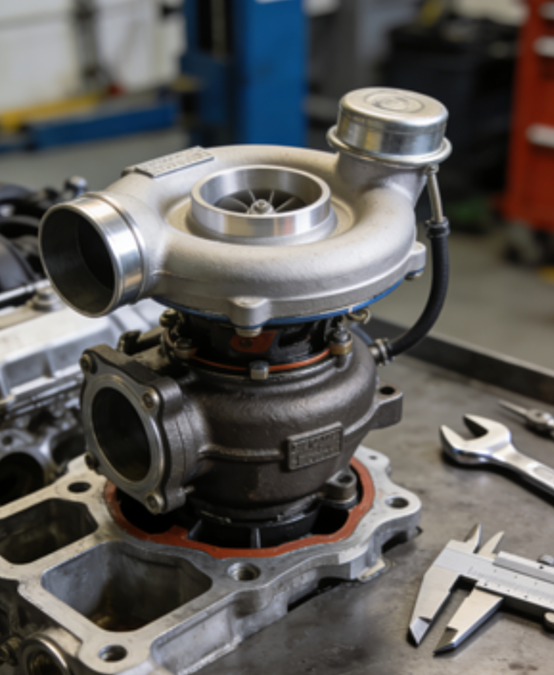
Nearly all advantages of this four‑cylinder pickup engine stem from its factory‑fitted turbocharger. Rather than implementing complex twin‑turbo hardware, GM selected a single‑turbo twin‑scroll configuration optimized for pickup‑truck duty, supported by a suite of complementary subsystems. The combination balances responsiveness, stability and durability for the high‑frequency, high‑stress operating cycles of pickup trucks.
The engine uses a BorgWarner‑supplied single‑turbo twin‑scroll turbocharger, paired with an integrated exhaust manifold, electronic wastegate and standalone intercooler system. This hardware set directly addresses well‑known pain‑points of older turbo setups: turbo lag, high‑temperature power fade and elevated failure rates. Many readers may wonder why high‑performance pickups do not adopt twin‑turbo layouts. The core reason is that pickups prioritize consistent, immediate and sustained power delivery, not absolute peak track‑oriented output.
Single‑turbo hardware features fewer components, lower failure risk and reduced thermal mass. This enables faster engine warm‑up and superior cold‑climate adaptability. Its simpler design also translates to lower repair and component‑replacement costs, easing maintenance burdens. For pickups subjected to constant heavy‑duty use, stability and practicality outweigh maximum theoretical performance.
Turbo lag — characterized by sluggish launch, delayed throttle reaction and abrupt power onset — plagued older turbocharged vehicles and degraded driving experience. GM heavily optimized the L3B’s turbocharger system to achieve class‑leading throttle responsiveness.
Internal GM test data shows: from a steady 1500‑rpm idle condition, wide‑open‑throttle application delivers 90 % of maximum torque in just 2.5 seconds. In real‑world scenarios including standing‑start traffic launches, trailer pull‑aways and hill‑climb acceleration, the “sound without motion” sluggish feeling is absent. Following the 2022 model‑year update, the torque delivery profile was further refined. Strong thrust is available at 1500 rpm, with peak torque arriving at 3000 rpm. Power builds linearly and smoothly, combining the low‑rpm strengths of diesel engines without the diesel‑style shortfalls at higher revs for greatly improved driving refinement.
The OEM BorgWarner turbocharger uses materials and construction engineered for pickup‑truck heavy payloads, high operating temperatures and frequent hard use, offering robust heat resistance, wear resistance and resistance to performance fade. Its turbine wheel is manufactured from high‑temperature‑resistant alloy to withstand sustained high‑heat conditions under heavy engine load. The shaft assembly receives dedicated, independent oil‑supply circuits for continuous lubrication and thermal management of turbocharger core components.
Turbocharger service life largely depends on owner maintenance habits. The factory turbocharger is not classified as a consumable wear part. With clean engine oil, proper operating practices and prevention of dry‑run high‑temperature conditions, turbocharger bearings and wheels can operate reliably for long intervals. Trouble‑free service well beyond 200 000 miles is typical, easily satisfying the demands of long‑term heavy‑duty pickup usage.
After seven years of market evolution and multi‑million‑unit production volume, the real‑world reliability of Chevrolet’s 2.7T TurboMax engine is well‑validated. Compared with GM’s classic V8 powertrains, this turbo four‑cylinder exhibits lower overall failure rates and simpler servicing — provided recommended maintenance procedures are followed.
General Motors covers the powertrain of 2024‑model‑year Silverado 2.7T vehicles with a 6‑year / 100 000‑mile warranty, matching coverage for its Duramax diesel engines. This demonstrates corporate confidence in the turbocharged engine’s reliability. Feedback from overseas automotive‑owner forums yields mixed subjective impressions, though key advantages stand out.
Commonly cited strengths among owners: strong low‑end torque, capable towing performance, and excellent highway fuel economy. Two‑wheel‑drive variants achieve 22 mpg combined, and many owners report real‑world highway cruising figures up to 24.9 mpg. Additionally, the engine accommodates regular‑grade gasoline, lowering day‑to‑day operating costs and offering flexibility across varying regional fuel qualities.
Most criticisms relate to NVH characteristics: the engine lacks the rich, iconic exhaust note of V8 powertrains, and minor fine‑grained vibration can be perceived at idle. Early‑model vehicles paired with the 8‑speed automatic transmission occasionally exhibited shift‑shudder occurrences, though these do not compromise mechanical reliability or power output.
When owners encounter power degradation, abnormal noises or minor oil seepage, they frequently suspect turbocharger assembly damage. Field data indicates actual turbocharger core failures are uncommon. Most symptoms originate from peripheral auxiliary parts and inherent direct‑injection‑engine characteristics.
First, common turbo‑adjacent concerns on high‑mileage units include carbon buildup within turbocharger oil feed lines, sticking electronic wastegate actuators, and intercooler‑system air leaks. These conditions result in slower power response, reduced acceleration and faint odd noises. Second, as a direct‑injection powerplant, intake‑valve carbon accumulation occurs over time. Beyond approximately 70 000 miles, this may bring slight idle roughness and marginally elevated fuel consumption. This is a widespread direct‑injection phenomenon unrelated to turbocharger quality.
Separately, certain early‑production 2023 Colorado units were subject to a recall for casting cracks in the engine block (with full engine replacement performed at no customer cost). This defect bears no connection to the turbocharger system. Other minor documented concerns include spark‑plug misfire events, accessory‑belt premature wear, sensitive high‑pressure fuel pumps, and occasional torque‑converter shudder in the 8‑speed transmission. None of these involve the turbocharger core assembly. Overall, the turbocharger ranks among the most robust components on this engine.
Identical turbocharger hardware sees drastically different loading and wear rates depending on the host vehicle. The full‑size Silverado has a curb weight nearly twice that of the Colorado. Turbocharger intervention occurs more frequently and under sustained higher pressure during acceleration, cruising and towing. Consequently, oil degradation rates and turbocharger thermal stress are substantially higher than on the midsize pickup.
For Silverado operators, shortening oil‑change intervals is advisable. Reducing the factory‑recommended 7500‑mile service interval down to 5000 miles preserves oil lubrication and heat‑dissipation performance, mitigating turbocharger wear and extending service life.

For Chevrolet 2.7T TurboMax vehicles, the upper bound of powertrain longevity hinges heavily on turbocharger system care. Responsible vehicle‑operating habits and scheduled maintenance prevent the vast majority of potential failures. Below is standardized maintenance guidance and diagnostic tips covering the full model range.
1. Consistently use high‑quality full‑synthetic engine oil, and adhere to 5000‑7500‑mile oil‑change intervals. Do not rely on marketing claims supporting 10 000‑mile extended‑drain oils. Clean oil is critical for turbocharger‑bearing lubrication and heat removal.
2. Avoid abusive operating practices. Refrain from heavy‑throttle or heavy‑load operation immediately after a cold start; allow time for oil to fully circulate through the turbocharger assembly. After extended high‑speed driving, towing or steep hill climbing, allow 30 seconds of idle time before shutdown. This permits oil to dissipate residual turbocharger heat and prevents oil coking and dry‑contact component damage.
3. Implement periodic targeted inspections. At every service, examine turbocharger oil feed‑and‑return lines, sealing gaskets and intercooler piping. Address minor oil weeping, loose connections or cracked components early, stopping minor defects from escalating into complete turbocharger‑assembly failure. Clean intake‑valve carbon deposits every 60 000‑80 000 miles, while inspecting turbocharger wheels for contact‑scuffing or physical damage.
Owners can rapidly assess whether turbocharger service is needed using four key symptom indicators:
1. Black smoke under hard acceleration accompanied by pronounced power loss
2. Persistent abnormal noise originating from the turbocharger wastegate assembly
3. Sudden, substantial increases in engine‑oil consumption
4. Oil weeping or air leakage at intercooler‑pipe joints
If two or more of these symptoms appear, the turbocharger system warrants disassembly and inspection to replace faulty components and stop further fault progression.
For owners requiring turbocharger replacement: direct drop‑in OEM‑spec replacement turbochargers need no ECU re‑tuning. They deliver perfect fitment and zero compatibility risks while fully supporting stock heavy‑load and towing requirements. For enthusiasts seeking performance‑oriented upgrades for off‑road capability, an upgraded reinforced turbocharger cartridge together with revised wastegate and piping hardware can reliably raise output to 290‑300 horsepower. This enhancement preserves overall powertrain stability without modifying the base engine, representing a cost‑effective performance‑improvement route.
Overall, GM’s L3B / TurboMax 2.7‑liter inline‑four turbocharged engine is far more than a compliance‑driven solution to meet emissions standards. It represents a successful real‑world implementation of small‑displacement turbo technology tailored for pickup‑truck duty. By way of its refined single‑turbo twin‑scroll turbocharger system, it delivers low‑rpm high torque, fast responsiveness and solid reliability, avoiding the high fuel consumption and elevated servicing costs associated with traditional large‑displacement pickups.
Though it cannot replicate the sonorous V8 exhaust note, its towing and hill‑climbing capability prove fully competent in practical use‑cases. It brings improved fuel efficiency, simpler maintenance and proven long‑term reliability. Its purpose‑optimized turbocharger has undergone extensive real‑world market validation, featuring simple architecture, low failure incidence and great durability. With adherence to standard maintenance routines, it delivers sustained high performance well‑suited to the high‑frequency, heavy‑duty operating cycles of pickup trucks. Today it stands as one of the most well‑rounded powertrain choices within the light‑duty American‑style pickup segment.